

Introduction
Computer-assisted navigation, once rooted in arthroplasty and spine surgery, is rapidly expanding into sports medicine.1 Advances in intraoperative imaging, virtual/augmented reality, optical tracking, and computational modeling now allow orthopaedic surgeons to quantify alignment, soft-tissue balance, and joint kinematics in real time.2 As sports surgery moves toward greater precision and reproducibility, the key question is whether navigation represents a true new frontier—or a refined extension of existing techniques.
Rationale: Precision and Optimization of Surgical Procedures for Athletes
Athletes present a uniquely demanding surgical challenge. Their joints experience high mechanical loads, functional thresholds are narrow, and expectations for rapid, reliable return to play remain uncompromising. Traditional sports procedures—anterior cruciate ligament (ACL) reconstruction, tibial tubercle osteotomy, and shoulder stabilization—have relied heavily on surgeon experience supported by arthroscopy and preoperative imaging. Yet variability persists; tunnel malposition, for example, is implicated in up to 60% of ACL revisions in some series.3 Navigation aims to reduce this variability by providing real-time feedback on tunnel orientation, graft isometry, bone block positioning, osteotomy correction, and anchor trajectory.4 In doing so, it augments surgical precision while preserving principles rooted in anatomy and biomechanics.
Current Applications Across Common Sports Procedures
ACL Reconstruction
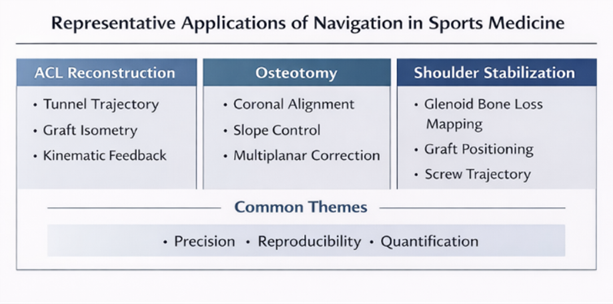
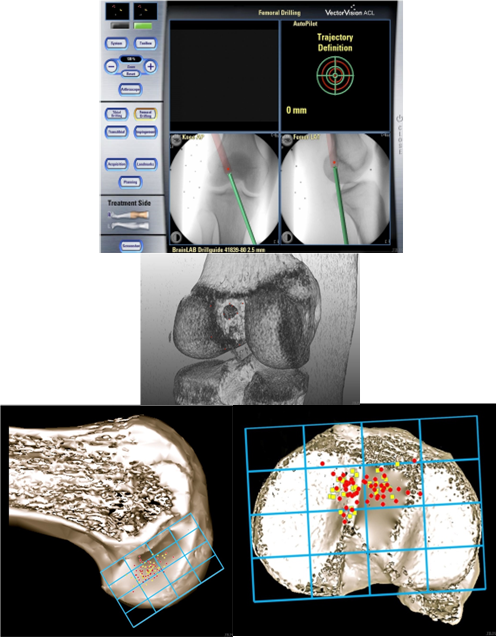
ACL reconstruction has been a primary focus of navigation in sports medicine. Accurate tibial and femoral tunnel placement is critical for success, yet conventional arthroscopic techniques demonstrate considerable variability.5 Navigation systems, including optical tracking platforms, were introduced to improve tunnel accuracy and provide intraoperative kinematic feedback, enabling visualization of tunnel trajectories relative to native footprints and assessment of rotational alignment throughout the flexion arc.1,6 Biomechanical studies demonstrate improved tunnel positioning and reduced inter-surgeon variability; however, clinical evidence remains mixed, with meta-analyses showing no consistent improvements in functional outcomes or revision rates.6 Whether these technical advantages translate into improved durability or faster return to sport remains uncertain.
Osteotomies and Alignment Correction
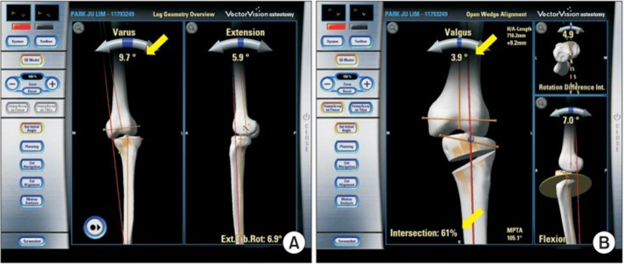
High tibial, distal femoral, and tibial tubercle osteotomies demand precise correction, as small deviations can significantly alter knee load distribution and patellofemoral mechanics.7 Conventional techniques are limited by intraoperative imaging variability, limb positioning, and reliance on surgeon experience, resulting in occasional unintended slope changes or undercorrection.8 Navigation provides real-time feedback on coronal and sagittal alignment, enabling more reproducible correction and improved control in multiplanar deformities.9 Early studies demonstrate improved accuracy and reduced variability compared with conventional methods.7 However, whether these technical advantages translate into superior functional outcomes or reduced revision rates remains under investigation, highlighting both the promise and current limitations of navigation in sports-aligned osteotomies.10
Shoulder Stabilization and Glenoid Reconstruction
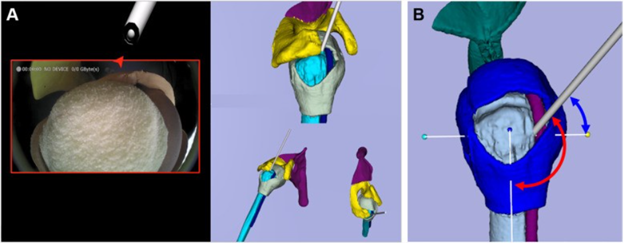
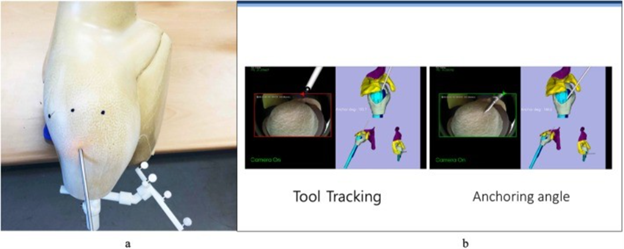
Navigation is increasingly applied in shoulder surgery, spanning arthroplasty, stabilization, and glenoid reconstruction.11 In arthroplasty, computer-assisted and mixed-reality platforms enable precise assessment of glenoid version, inclination, and implant positioning, improving reproducibility and reducing malalignment.12 In sports procedures such as Latarjet, Bankart repair, and bone augmentation, navigation allows real-time evaluation of bone loss, graft placement, and screw trajectory while maintaining focus on the operative field.13 This capability may be particularly relevant in instability and bone augmentation procedures, where millimeter-scale deviations in graft position can meaningfully affect joint stability and durability. Early studies demonstrate improved technical accuracy, though whether these advantages translate into superior functional outcomes or faster return-to-sport remains unclear.14
Limitations and Barriers to Adoption
Despite its potential, the integration and adoption of computer-assisted navigation in sports medicine face several practical and systemic challenges. Setup time, system and capital investment, and additional instrumentation can impact operative efficiency, while optical systems require stable line-of-sight and intraoperative workflows must adapt to accommodate tracking arrays.12 Learning curves are generally manageable, but consistent and effective use depends on institutional support, trained personnel, and sufficient case volume.11 Most importantly, clinical outcome evidence remains limited: although navigation consistently improves technical accuracy, there is currently a lack of definitive data demonstrating faster return to play, reduced revision rates, or improved long-term patient outcomes across most procedures.6 This evidence gap continues to influence adoption patterns, particularly in high-volume or resource-limited settings, and underscores the need for rigorous clinical studies to validate the promise of navigation as a transformative tool in sports surgery.9
The Path Forward: Objective, Adaptive, and Patient-Specific Navigation Platforms
The potential of navigation extends beyond technical accuracy. By capturing intraoperative kinematics, ligament tension profiles, and alignment metrics, navigation enables objective quantification that may guide patient-specific planning and support large-scale outcome analytics.11 Integration with robotics, mixed reality, and AI-driven modeling may further accelerate this trajectory, enabling real-time decision support and more individualized surgical strategies tailored to an athlete’s anatomy and demands.12 Over time, these advancements could shift surgical practice from reliance on surgeon experience alone toward a fully data-informed, precision-driven approach, enabling reproducibility across surgeons and institutions and potentially improving both functional outcomes and long-term durability of sports procedures.9 Such developments position navigation not merely as a technical aid, but as a broader platform for innovation, learning, and personalization in high-performance musculoskeletal care.
Conclusions
Computer-assisted navigation represents an important evolution in sports medicine, with the potential to enhance precision, reproducibility, and intraoperative decision-making across high-demand procedures. At present, it functions more as an enabling technology than a paradigm shift. However, as quantitative intraoperative data accumulate and integration with robotics, mixed reality, and artificial intelligence-driven decision support advances, navigation may increasingly support more objective and patient-specific care.6 Whether these technical gains translate into improved return to sport, complication rates, or long-term durability remains uncertain and warrants continued investigation. For now, navigation stands as a promising tool whose ultimate clinical impact is still being defined.14
References
- Zaffagnini S, Urrizola F, Signorelli C, et al. Current use of navigation system in ACL surgery: a historical review.Knee Surg Sports Traumatol Arthrosc. 2016;24(11):3396-3409. doi:10.1007/s00167-016-4356-y
- Shen H, Liu H. Progress in clinical application of computer-assisted orthopedic surgery. Digital Medicine. 2023;9(2):e00002.doi:10.1097/DM-2023-00002
- Hauer TM, Herman ZJ, Cunningham M, Fisch A, Hughes JD. Considerations in revision of anterior cruciate ligament reconstruction in the high-level athlete.Annals of Joint. 2025;10(0).doi:10.21037/aoj-25-25
- Figueroa F, Figueroa D, Guiloff R, Putnis S, Fritsch B, Itriago M. Navigation in anterior cruciate ligament reconstruction: State of the art.J ISAKOS. 2023;8(1):47-53.doi:10.1016/j.jisako.2022.09.001
- Foo WYX, Chou ACC, Lie HM, Lie DTT. Computer-assisted navigation in ACL reconstruction improves anatomic tunnel placement with similar clinical outcomes. Knee.2022;38:132-140. doi:10.1016/j.knee.2022.08.006
- Yavari E, Moosa S, Cohen D, et al. Technology-assisted anterior cruciate ligament reconstruction improves tunnel placement but leads to no change in clinical outcomes: a systematic review and meta-analysis.Knee Surg Sports Traumatol Arthrosc. 2023;31(10):4299-4311.doi:
- Song SJ, Bae DK. Computer-Assisted Navigation in High Tibial Osteotomy. Clin Orthop Surg. 2016;8(4):349-357. doi:10.4055/cios.2016.8.4.349
- Nha KW, Shin YS, Kwon HM, Sim JA, Na YG. Navigated versus Conventional Technique in High Tibial Osteotomy: A Meta-Analysis Focusing on Weight Bearing Effect. Knee Surg Relat Res. 2019;31(2):81-102. doi:10.5792/ksrr.17.090
- Li T, Badre A, Alambeigi F, Tavakoli M. Robotic systems and navigation techniques in orthopaedics: current state and emerging applications.Appl Sci. 2023;13(17):9768. doi:10.3390/app13179768
- Bastos R, Magnussen RA, LaPrade RF. High tibial osteotomy in the athlete: indications, techniques, and outcomes.Sports Med Arthrosc Rev. 2019;27(4):141-149. doi:10.1097/JSA.0000000000000252
- Hill JR, Jackson GR, To W, Zmistowski B, Movassaghi A, Sabesan VJ. Navigating the future: A comprehensive review of technology in shoulder arthroplasty.J Hand Microsurg. 2025;17(3):100224. doi:10.1016/j.jham.2025.100224
- Larose G, Greene AT, Jung A, et al. High intraoperative accuracy and low complication rate of computer-assisted navigation of the glenoid in total shoulder arthroplasty.J Shoulder Elbow Surg. 2023;32(6S):S39-S45. doi:10.1016/j.jse.2022.12.021
- Huang J, Wei L, Zhu B, et al. Navigation-guided arthroscopic transglenoid fixation for autologous bone grafting in recurrent shoulder instability.Arthrosc Tech. 2022;11(11):e2003-e2011. doi:10.1016/j.eats.2022.07.024
- Marescalchi M, El Motassime A, Andriollo L, et al. Computer-assisted navigation in shoulder surgery: current concepts and future directions.J Clin Med. 2023;12(18):5834. doi:10.3390/jcm12185834

