
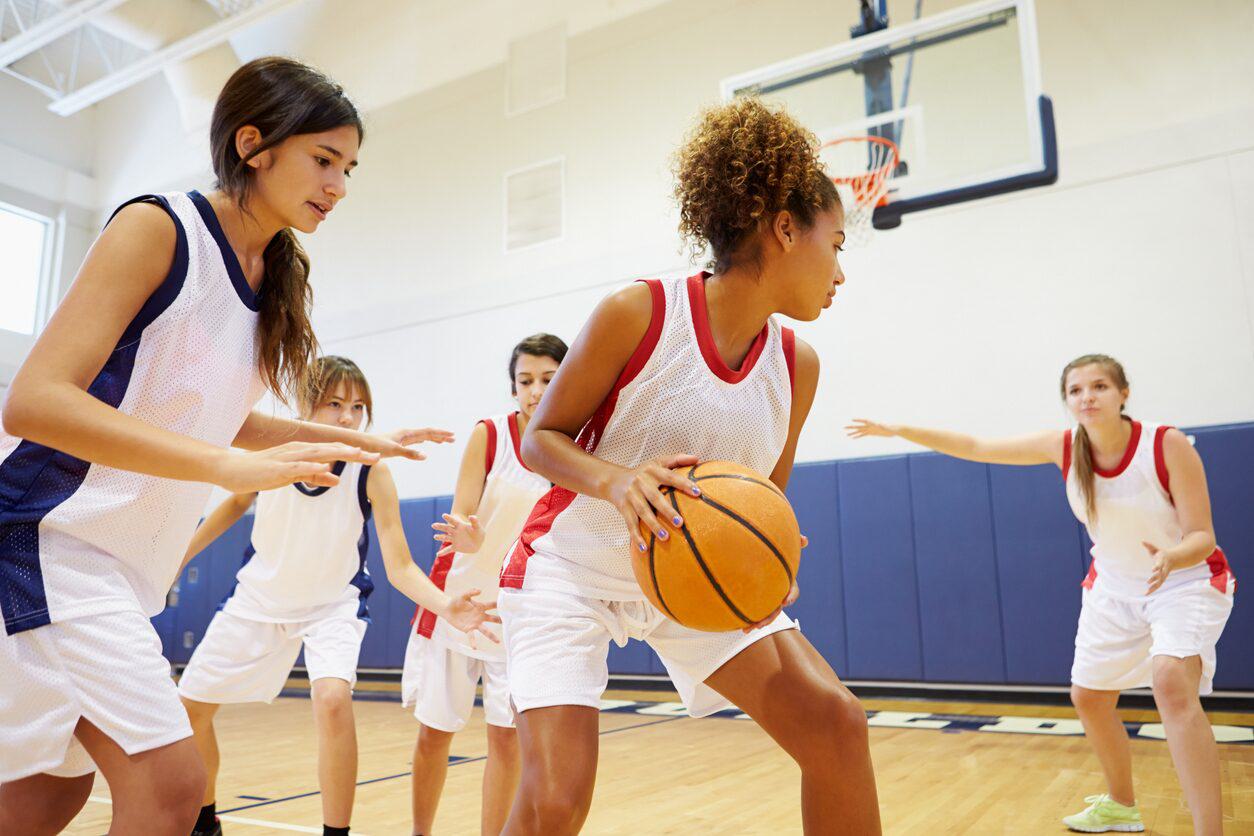
Basketball was first introduced to the world in 1891 by Dr. James Naismith, using a soccer ball and two peach baskets. Today’s high-speed, physical sport scarcely resembles the original game. The fast-paced nature of modern basketball’s game can result in a variety of injuries. It is estimated that more than 1.6 million injuries are associated with basketball each year.
What types of injuries are most common in basketball?
Ankle sprains
Jammed fingers
Knee injuries
Deep thigh bruising
Facial cuts
Foot fractures
How are basketball injuries treated?
Ankle Sprains
Treatment for an ankle sprain involves rest, ice, compression, and elevation (RICE). The need for X-rays and evaluation by a physician is determined on a case-by-case basis and depends on the severity and location of pain. Difficulty bearing weight is an important physical exam finding. An injury to the ankle in a child who is still growing could represent a simple sprain or could be the result of an injury to the growth plates located around the ankle and should be evaluated by a physician. Participation in physical therapy to work on stability and proprioception is very important after these injuries.
Jammed Fingers
Jammed fingers occur when the ball contacts the end of the finger and causes significant swelling of a single joint. Application of ice and buddy taping the finger to the adjacent finger may provide some relief and allow the athlete to return to play. If pain and swelling persist, evaluation by a physician or athletic trainer is recommended and an x-ray of the finger may be needed.
Knee Injuries
Basketball requires extensive stop and go and cutting maneuvers which can put the ligaments and menisci of the knee at risk. Injury to the medial collateral ligament is most common following a blow to the outside of the knee and can be often be treated with ice, bracing and a gradual return to activity. An injury to the anterior cruciate ligament is a more serious injury and can occur with an abrupt change in direction and landing for the jump.
Deep Thigh Bruising
Treatment includes rest, ice, compression, and elevation. Commercially available girdles with thigh pads are now available for protection.
Facial Cuts
Depending on the depth of the injury, the cut may require stitches or a “butterfly” sterile tape. Ice may provide pain relief and decrease swelling. Players can return to play after all blood is removed and the wound is dressed.
Stress Fractures
Stress fractures can occur from a rapid increase in activity level or training or from overtraining. Stress fractures in basketball most commonly occur in the foot and lower leg (tibia). Once diagnosed, a period of immobilization and non-weight bearing is recommended. Return to play is permitted once the fracture has completely healed and the athlete is pain free and has been cleared by a physician. Stress fractures which do not heal with rest and activity restriction sometimes require surgical fixation.
How can basketball injuries be prevented?
- Have a pre-season physical examination and follow your doctor’s recommendations.
- Hydrate adequately. Waiting until you are thirsty is often too late to hydrate properly.
- Pay attention to environmental recommendations, especially in relation to excessively hot and humid weather, to help avoid heat illness.
- Maintain proper fitness. Injury rates are higher in athletes who have not adequately prepared physically.
- After a period of inactivity, progress gradually back to full-contact basketball through activities such as aerobic conditioning, strength training, and agility training.
- Avoid overuse injuries. More is not always better! Many sports medicine specialists believe it is beneficial to take off at least one season each year. Try to avoid the pressure that is exerted on young athletes to over-train. Listen to your body and decrease training time and intensity if pain or discomfort develops. This will reduce the risk of injury and help avoid burn-out.
- Talk with your coach and/or athletic trainer about an ACL injury prevention program and incorporating the training principles into team warm-ups.
- After an injury, return to play only when clearance is granted by a health care professional.
Reviewed November 2025 by: Elizabeth R. Dennis, MD MS
Contributing experts: Daniel E. Matthews, MD; Jo A. Hannafin, MD, PhD
Sports Tips are brought to you by the American Orthopaedic Society for Sports Medicine. They provide general information only and are not a substitute for your own good judgment or consultation with a physician.
For more tip sheets and to find an expert near you, visit sportsmed.org/STOP
Copyright ©2025. American Orthopaedic Society for Sports Medicine. All rights reserved.
References
Miyasaka KC, Daniel DM, Stone ML. The incidence of knee ligament injuries in the general population. Am J Knee Surg. 4:43-48, 1991Griffin, Letha Y. MD, PhD.
Prevention of Noncontact ACL Injuries, American Academy of Orthopaedic Surgeons.
Taylor JB, Ford KR, Nguyen AD, Terry LN, Hegedus EJ. Prevention of Lower Extremity Injuries in Basketball: A Systematic Review and Meta-Analysis. Sports Health. 2015 Sep-Oct;7(5):392-8. doi: 10.1177/1941738115593441. Epub 2015 Jun 26. PMID: 26502412; PMCID: PMC4547118.
Lian J, Sewani F, Dayan I, Voleti PB, Gonzalez D, Levy IM, Musahl V, Allen A. Systematic Review of Injuries in the Men's and Women's National Basketball Association. Am J Sports Med. 2022 Apr;50(5):1416-1429. doi: 10.1177/03635465211014506. Epub 2021 Jul 2. PMID: 34213367.