

With so many bones, ligaments, tendons, and joints keeping hands and wrists working, there is ample opportunity for injury. In fact, injuries to the hand and wrist are some of the most common in athletes. However, if managed properly most heal without any significant long-term disability.
What are the most common sports-related hand and wrist injuries?
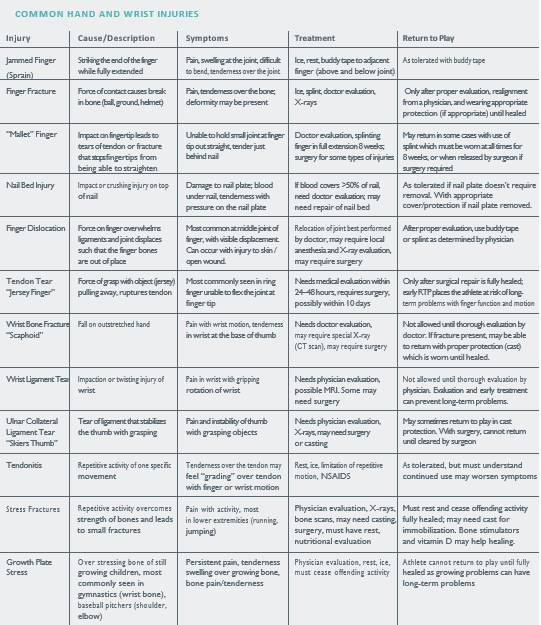
There are a number of injuries that may occur in an athlete’s hands or wrists. They can be classified into two main categories: traumatic (acute) and overuse (chronic).
Traumatic injuries are more likely to occur in athletes who participate in sports that require higher levels of contact (e.g., football, hockey, or wrestling), whereas overuse injuries result in athletes who participate in sports that require them to perform repetitive movements or experience repetitive force in the same joint or extremity (e.g., baseball, tennis, or golf).
Some common traumatic injuries in athletes include joint dislocations, sprains, muscle strains, broken bones, tendon inflammation, and ligament tears. The most common location for a fracture or broken bone in the athletic population is the hand, particularly the fingers.
Overuse injuries are stress-induced and include soft tissue and tendon inflammation, nerve injury, and stress fractures. Long-term disability is less likely to occur from overuse injuries than from traumatic injuries. However, if left untreated, an athlete’s sports performance may be significantly diminished. Most of these injuries resolve with rest and modification of activity to avoid the repetitive stress, combined with physical therapy to better condition supporting musculature in the involved area and support technique and form that will help to prevent a recurrent injury. However, sometimes more involved treatment including surgery may be required if symptoms do not resolve with first-line treatment.
What should I do if I injure my hand or wrist?
Should you sustain a hand or wrist injury while participating in a game where a team physician is not present, seek immediate medical care if any of the following symptoms are present:
- Severe pain
- Severe swelling
- Numbness
- Coldness or grayness in the finger, hand, or wrist
- Abnormal twisting or bending of the finger or hand
- A clicking, grating, or shifting noise while moving your finger, hand, or wrist
- Bleeding that does not slow and persists for more than 15 minutes.
Contact your physician during regular practice hours if mild wrist pain, bruising, or swelling after an injury persists and does not improve after two weeks.
For minor hand injuries, home treatment, including rest, ice, compression, and elevation to the effected limb can help relieve pain, swelling, and stiffness. An anti-inflammatory medication such as ibuprofen or naproxen may also be taken to help with the pain and inflammation.
What treatment options are available for hand and wrist injuries?
Treatment depends on the location, type, duration, and severity of the injury. While surgery is needed for some injuries, such as ligament tears, medication, “buddy-taping” (taping the injured finger to a neighboring one for support), splints, braces, casts, or physical therapy may be used as a treatment option. Your doctor
will determine the best option, taking into consideration short- and long-term damage, deformities, and stiffness.
How can I prevent a hand or wrist injury?
Wearing wrist guards, gloves, and stretching are just a few ways to help prevent a traumatic hand or wrist injury. You can prevent overuse injuries by taking breaks to rest the hands or wrists, using proper posture and technique, and utilizing protective equipment.
Reviewed November 2025 by David L. Bernholt, MD
Expert Consultant: Dan Matthews, MD
Sports Tips are brought to you by the American Orthopaedic Society for Sports Medicine. They provide general information only and are not a substitute for your own good judgment or consultation with a physician.
For more tip sheets and to find an expert near you, visit sportsmed.org/STOP
Copyright ©2025. American Orthopaedic Society for Sports Medicine. All rights reserved.
Additional Resources
American Physical Therapy Association American Medical Society for Sports Medicine