

Volleyball is one of the world’s most popular sports, played by over 800 million people and growing annually.1 Girls high school volleyball has increased 15% since 2002 and 8.4% since 2012, making it the second most popular sport among youth females.2 With four U.S. Women’s Pro-leagues available by 2024 (Athletes Unlimited, League One Volleyball, Pro Volleyball Federation, and Volleyball League of America) and the U.S. Women’s Indoor team winning their first Olympic gold in Tokyo in 2022, women’s volleyball participation is at an all-time high.1,3,4
Volleyball involves repetitive overhead movements such as serving and spiking, and while players aren’t typically labeled “overhead athletes,” they often experience injuries similar to those of throwers. They are also at risk for acute and chronic injuries from repeated jumping, landing, and diving. One study found that 93% of professional volleyball players reported knee, low back, or shoulder complaints during the season.6 Baugh et. al found that injury rates are generally higher in women than men, especially during practice.5 Acute diagnosis and proper treatment are essential for recovery and long-term health.
Volleyball is most commonly played in two settings: indoor and beach. Indoor volleyball is the second most funded women’s team sport in the National Collegiate Athletic Association (NCAA), while women’s beach volleyball is the fastest growing Division I sport.10 Differences in court surface and environment lead to distinct movement patterns and injury risks.7,11
Injury rates are higher in indoor Division I NCAA women’s volleyball (5.3 injuries per 1,000 hours) than in beach volleyball (1.8 per 1,000 hours).8 Knees are most affected in indoor players while shoulders are most affected in beach players. Indoor athletes also have more concussions (7.5% indoor vs 6.5% beach) and knee injuries (16.7% indoor vs 7.6% beach).8 Meanwhile, beach players report more abdominal strains (11.8% beach vs 4.7% indoor) and longer recovery times (24 vs 11 days).6 However, an earlier study reported differing trends.9
Upper Extremity
Hand injuries
Hand and wrist injuries are common in volleyball, accounting for nearly 9% of all related injuries. Blockers and hitters are particularly at risk due to ball impact, net contact, or collisions.
A previous study of over 200 cases by Bhairo et al found that most injuries occurred during blocking (36%, defense (37%), or falling (18%).16 Sprains and strains were most common at 39%, followed by fractures (25%) and contusions (16%), with the thumb metacarpal-phalangeal joint most frequently affected. Baugh et al found that hand/wrist injuries caused 12.9% of time-loss injuries in men compared to 3.7% in women.5
Another study by Kostianen et al described blunt wrist trauma leading to radial and ulnar artery injuries, known as antebrachial-palmar hammer syndrome, which can cause pain and distal hand cyanosis.17 These injuries may follow contact with the floor or ball during diving or “pancake” hits and require prompt evaluation.12
Shoulder Injuries
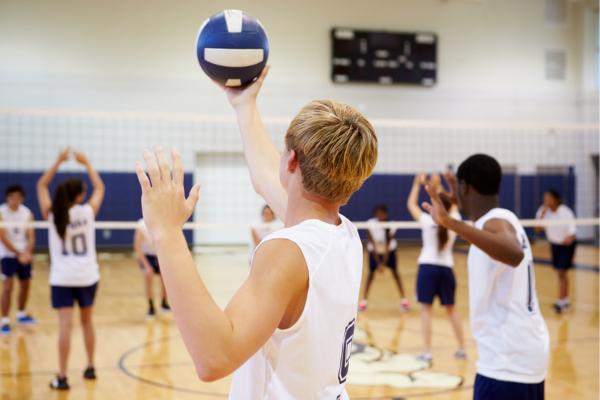
The shoulder joint accounts for 8% to 20% of all volleyball related injuries.8,12,15 A recent study reported it as the most injured body part in beach volleyball (15.5%) and second most in indoor volleyball (10.8%).6 Women had higher rates of overuse injuries causing short-term participation restriction.5 Many of these result from repetitive overhead movements, performed up to 40,000 times annually by professionals.20
Understanding the biomechanics of the spike and serve is key. These can be divided into three separate phases: cocking, acceleration, and deceleration.21 During the cocking phase, the shoulder reaches maximal abduction and external rotation, then rapidly transitions to internal rotation and adduction during acceleration up to ball strike.22 Repeated stress during these phases can cause anatomical and functional changes in the shoulder, increasing injury risk over time in volleyball athletes.
Shoulder GIRD/Strength Imbalance
One of the most common adaptations that volleyball players may develop is a change in the arc of motion including a glenohumeral internal rotation deficit (GIRD). This may develop overtime due to tightness of the posterior capsule and rotator cuff or from humeral retroversion.22,23 GIRD is often defined as a 20° or greater loss of IR vs the nondominant shoulder, and may lead to an increased risk of internal or external impingement that can lead to injuries of the rotator cuff, superior labrum anterior to posterior (SLAP), and glenohumeral instability.24,25 Several studies investigating volleyball players have shown the mean magnitude of GIRD of approximately 10°, whereas the prevalence of pathologic, GIRD (>20°) can be present in nearly 15% to 18% of volleyball and overhead athletes.26–28 Treatment options for GIRD are often conservative, focusing on posterior capsular stretching and strengthening of the posterior cuff and periscapular muscles.
Suprascapular Neuropathy
Suprascapular neuropathy, although uncommon in the general population, affects 9% to 34% of volleyball players.29,30,32,33 The suprascapular nerve, originating from the brachial plexus, is commonly compressed at the spinoglenoid notch in athletes, likely due to eccentric infraspinatus contraction during serving, hypertrophy of the spinoglenoid ligament, or factors such as strain, traction, or ganglion cysts. 22,29–31,34–39 This can cause painless weakness in external rotation and infraspinatus atrophy, though performance is rarely affected due to preserved internal rotation strength and compensatory function of the teres minor. A recent study by Mazza et al suggests decreased prevalence may be linked to the shift from serves to jump topspin serves.32
Shoulder Instability/Capsular Injury
Another shoulder injury that is seen less frequently in volleyball players, but is equally important to consider is a humeral avulsion of the glenohumeral ligament (HAGL).23,40 During the spiking motion of volleyball, the contact point coincides with the maximal abduction/elevation of the glenohumeral joint. Overtime this can lead to repetitive microtrauma of the inferior axillary recess, and capsule and result in a subsequent HAGL lesion. Taljanovic et al evaluated a series of four female collegiate volleyball players with chronic activity-related pain, three had a HAGL lesion while 3 had partial rotator cuff tears from internal impingement.23 Each of these individuals underwent surgical intervention and all four returned to volleyball within six to eight months from surgery.
Lower Limb Injuries
Knee Injuries
Patellar Tendinopathy
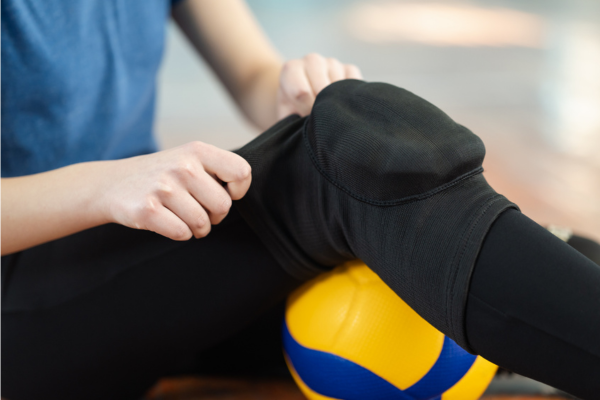
Success in volleyball requires repeated jumping and landing, placing significant strain on the knee and often leading to overuse injuries. Baugh et al found that the knee is the most frequently injured body part causing minimal time loss from play. Meanwhile, Reeser et al found that overuse injuries make up 38.1% of collegiate and 15.1% of high school knee injuries, with patellar tendonitis (PT) being the most common. 39 This chronic condition can limit activity, and patellar tendinopathy and PT are the leading knee injuries in collegiate players. Risk factors include male sex, high body mass index, physically demanding work, and years of play.41,42
Knee Ligament Injuries
Ligamentous and meniscal knee injuries in volleyball often result from landing after a jump. These accounted for time-loss injuries in 16.3% (50/306) of female and 25.5% (13/51) of male athletes. Over 75% of high school anterior cruciate ligament (ACL) injuries occurred during landing, and more than 85% were noncontact.43 Magnetic resonance imaging (MRI) is often useful after history and physical exam to confirm diagnosis and evaluate ligament, cartilage, and meniscal pathology.
A study by Deda et al found the most injured knee structure in volleyball was the medial collateral ligament (30.1%), followed by the patella/patellar tendon (26.5%), ACL (24.4%), meniscus (13.0), lateral collateral ligament (5.0%), and posterior cruciate ligament (2.1%).44 Reeser et al found that ACL injuries occurred more often in high school players (9.3%) than in college athletes (4.4%), were more common in women, and mostly happened during practice.40 By position, ACL tears were most frequent in spikers (41.2%) and middle blockers (29.4%), followed by setters (17.6%), libero’s (8.8%), and opposite hitters (3%).45
Ankle/Foot Injuries
Sprains
Ankle sprains are the most common volleyball injury among high school and college players.46 Additionally, these sprains cause 21.7% of time-loss injuries in women.5 They frequently occur near the net, especially in blockers and outside hitters, when landing on another player’s foot. Rates are higher in collegiate players than high school athletes, with 6.6 vs 4.3 injuries per 10,000 athletic exposures in practice and 10.4 vs 4.3 in competition.42
Achilles Tendinopathy
Repetitive jumping and landing can also injure the Achilles tendon. Chronic inflammation may progress to tendonitis, with tendon thickening and softening visible on imaging.48 Treatment includes rest, ice, anti-inflammatory medication, and rehabilitation emphasizing eccentric stretching, strengthening, and gradual return to play. Recovery may take three to 12 months, and up to 25% of athletes experience persistent symptoms even 10 years later. 49,50
Sand Toe
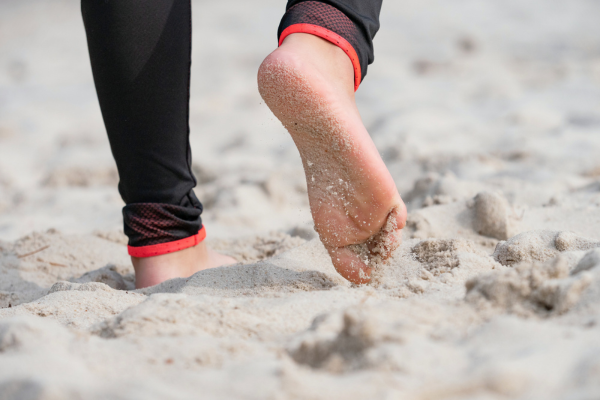
Toe injuries are common in beach volleyball, which is played barefoot. “Sand toe” results from hyperflexion of the great toe’s metatarsophalangeal joint. Treatment includes rest, ice, and anti-inflammatory medication, with prevention through taping of stiff orthotics outside play. Recovery may take up to six months.9
Spine Injuries
Low Back Pain
Repetitive lumbar flexion, extension and rotation in volleyball increase the risk of low back injury (LBI), with 63% to 86% of players reporting past lower back pain.51,52 In NCAA female athletes (2009-2015), LBI occurred at 4.89 per 10,000 exposures, was 2.76 times more likely in preseason, and occurred most often in practice, especially among outside hitters and middle blockers according to a recent NCAA Injury Surveillance Program study.51 Most (72%) returned within 24 hours, none missed more than 21 days, and no surgical interventions were required.47
Spondylolysis
More severe low back injuries can include spondylolysis, a stress fracture of the pars interarticularis, sometimes caused by repetitive hyperextension when hitting.53 Imaging with X-ray, MRI, or SPECT may be used for diagnosis. In professional beach volleyball players, MRI revealed degenerative disc changes in 79% and spondylolysis in 21%—nearly triple the general population rate—most of often at L5-S1.49 However, these findings did not correlate with low back pain and should be interpreted with caution.
Concussion
Although volleyball is noncontact, concussions occur in 7.1% to 7.5% of players.54 In a national survey of Volleyball Canada members, Meeuwisse et al found that most (57%) follow ball-to-head contact, with 20.2% from player-to-player and 15.5% from player-to-floor contact.50 Nearly half (46.5%) happen in practice, 38.4% in games, and 15.1% during warm-up. Baugh et al found that concussions account for 19.4% of men’s and 14.8% of women’s volleyball injuries.5
Conclusion
Volleyball is rapidly growing in popularity, exposing athletes to both acute and chronic overuse injuries due to repetitive jumping, hitting, and blocking. Most injuries affect the lower extremities, with men experiencing more contact-related injuries and women more overuse injuries, likely due to differences in play style and early specialization. Overuse injuries are largely preventable through proper monitoring, flexibility training, and strength conditioning. As the sport expands in the United States, especially with the success of the Women’s National Team, sports physicians must understand these injury patterns to provide effective treatment and ensure safe return to play.
References
1. Naveen P. History of Volleyball: From Origins to the Olympics. Olympics. Published online February 5, 2023. https://olympics.com/en/news/w...
2. Bachman R. Girls Are Leaving High School Basketball, and Here’s Why.Girls Are Leaving High School Basketball, and Here’s Why. Published September 20, 2022.
3. Friedman V. Why the Spike in Volleyball Participation? https://www.espn.com/espnw/spo...
4. Hruby E. NCAA Volleyball Championship Draws Record 1.2 Million Viewers. https://justwomenssports.com/a...
5. Baugh CM, Weintraub GS, Gregory AJ, Djoko A, Dompier TP, Kerr ZY. Descriptive Epidemiology of Injuries Sustained in National Collegiate Athletic Association Men’s and Women’s Volleyball, 2013-2014 to 2014-2015. Sports Health. 2018;10(1):60-69. doi:10.1177/1941738117733685
6. Skazalski C, Bahr R, Whiteley R. Shoulder complaints more likely in volleyball players with a thickened bursa or supraspinatus tendon neovessels. Scand J Med Sci Sports. 2021;31(2):480-488. doi:10.1111/sms.13831
7. Smith CE, Nyland J, Caudill P, Brosky J, Caborn DNM. Dynamic trunk stabilization: a conceptual back injury prevention program for volleyball athletes. J Orthop Sports Phys Ther. 2008;38(11):703-720. doi:10.2519/jospt.2008.2814
8. Juhan T, Bolia IK, Kang HP, et al. Injury Epidemiology and Time Lost From Participation in Women’s NCAA Division I Indoor Versus Beach Volleyball Players. Orthop J Sports Med. 2021;9(4):232596712110045. doi:10.1177/23259671211004546
9. Aagaard H, Scavenius M, Jørgensen U. An epidemiological analysis of the injury pattern in indoor and in beach volleyball. Int J Sports Med. 1997;18(3):217-221. doi:10.1055/s-2007-972623
10. AVCA. Volleyball Fast Facts. 2015; American Volleyball Coaches Association. https://www.avca.org
11. Tilp M, Wagner H, Müller E. Differences in 3D kinematics between volleyball and beach volleyball spike movements. Sports Biomech. 2008;7(3):386-397. doi:10.1080/14763140802233231
12. Chandran A, Morris SN, Lempke LB, Boltz AJ, Robison HJ, Collins CL. Epidemiology of Injuries in National Collegiate Athletic Association Women’s Volleyball: 2014-2015 Through 2018-2019. J Athl Train. 2021;56(7):666-673. doi:10.4085/1062-6050-679-20
13. Young WK, Briner W, Dines DM. Epidemiology of Common Injuries in the Volleyball Athlete. Curr Rev Musculoskelet Med. 2023;16(6):229-234. doi:10.1007/s12178-023-09826-2
14. Eerkes K. Volleyball injuries. Curr Sports Med Rep. 2012;11(5):251-256. doi:10.1249/JSR.0b013e3182699037
15. Briner WW, Kacmar L. Common injuries in volleyball. Mechanisms of injury, prevention and rehabilitation. Sports Med. 1997;24(1):65-71. doi:10.2165/00007256-199724010-00006
16. Bhairo NH, Nijsten MW, van Dalen KC, ten Duis HJ. Hand injuries in volleyball. Int J Sports Med. 1992;13(4):351-354. doi:10.1055/s-2007-1021280
17. Kostianen S, Orava S. Blunt injury of the radial and ulnar arteries in volley ball players. A report of three cases of the antebrachial-palmar hammer syndrome. Br J Sports Med. 1983;17(3):172-176. doi:10.1136/bjsm.17.3.172
18. Lin JS, Samora JB. Surgical and Nonsurgical Management of Mallet Finger: A Systematic Review. J Hand Surg Am. 2018;43(2):146-163.e2. doi:10.1016/j.jhsa.2017.10.004
19. Ilyas AM, Ast M, Schaffer AA, Thoder J. de Quervain Tenosynovitis of the Wrist: J Am Acad Orthop Surg. 2007;15(12):757-764. doi:10.5435/00124635-200712000-00009
20. Kugler A, Krüger-Franke M, Reininger S, Trouillier HH, Rosemeyer B. Muscular imbalance and shoulder pain in volleyball attackers. Br J Sports Med. 1996;30(3):256-259. doi:10.1136/bjsm.30.3.256
21. Ferretti A, DeCarli, A. Shoulder injuries in volleyball. In: Reeser J, Bahr R, editors. Volleyball: Olympic Handbook of Sports Medicine. In: Chichester (GBR): Wiley; 2008.; :118-129.
22. von Eisenhart-Rothe R, Matsen FA, Eckstein F, Vogl T, Graichen H. Pathomechanics in atraumatic shoulder instability: scapular positioning correlates with humeral head centering. Clin Orthop Relat Res. 2005;(433):82-89.
23. DeFroda SF, Goyal D, Patel N, Gupta N, Mulcahey MK. Shoulder Instability in the Overhead Athlete. Curr Sports Med Rep. 2018;17(9):308-314. doi:10.1249/JSR.0000000000000517
24. Bailey LB, Shanley E, Hawkins R, et al. Mechanisms of Shoulder Range of Motion Deficits in Asymptomatic Baseball Players. Am J Sports Med. 2015;43(11):2783-2793. doi:10.1177/0363546515602446
25. Wilk KE, Macrina LC, Fleisig GS, et al. Correlation of glenohumeral internal rotation deficit and total rotational motion to shoulder injuries in professional baseball pitchers. Am J Sports Med. 2011;39(2):329-335. doi:10.1177/0363546510384223
26. Miura K, Tsuda E, Ishibashi Y. Glenohumeral Rotational Deficit and Suprascapular Neuropathy in the Hitting Shoulder in Male Collegiate Volleyball Players. PRM. 2019;4(0):n/a. doi:10.2490/prm.20190002
27. Saccol MF, Almeida GPL, de Souza VL. Anatomical glenohumeral internal rotation deficit and symmetric rotational strength in male and female young beach volleyball players. J Electromyogr Kinesiol. 2016;29:121-125. doi:10.1016/j.jelekin.2015.08.003
28. Whiteley R, Oceguera M. GIRD, TRROM, and humeral torsion-based classification of shoulder risk in throwing athletes are not in agreement and should not be used interchangeably. J Sci Med Sport. 2016;19(10):816-819. doi:10.1016/j.jsams.2015.12.519
29. Lajtai G, Wieser K, Ofner M, Raimann G, Aitzetmüller G, Jost B. Electromyography and nerve conduction velocity for the evaluation of the infraspinatus muscle and the suprascapular nerve in professional beach volleyball players. Am J Sports Med. 2012;40(10):2303-2308. doi:10.1177/0363546512455395
30. Lajtai G, Pfirrmann CWA, Aitzetmüller G, Pirkl C, Gerber C, Jost B. The shoulders of professional beach volleyball players: high prevalence of infraspinatus muscle atrophy. Am J Sports Med. 2009;37(7):1375-1383. doi:10.1177/0363546509333850
31. Cornu C, Nordez A, Bideau B. Shoulder rotators electro-mechanical properties change with intensive volleyball practice: a pilot study. Int J Sports Med. 2009;30(12):857-862. doi:10.1055/s-0029-1237390
32. Mazza D, Iorio R, Drogo P, et al. Did the prevalence of suprascapular neuropathy in professional volleyball players decrease with the changes occurred in serving technique? Phys Sportsmed. 2021;49(1):57-63. doi:10.1080/00913847.2020.1766344
33. Holzgraefe M, Kukowski B, Eggert S. Prevalence of latent and manifest suprascapular neuropathy in high-performance volleyball players. Br J Sports Med. 1994;28(3):177-179. doi:10.1136/bjsm.28.3.177
34. Challoumas D, Stavrou A, Dimitrakakis G. The volleyball athlete’s shoulder: biomechanical adaptations and injury associations. Sports Biomech. 2017;16(2):220-237. doi:10.1080/14763141.2016.1222629
35. Challoumas D, Dimitrakakis G. Insights into the epidemiology, aetiology and associations of infraspinatus atrophy in overhead athletes: a systematic review. Sports Biomech. 2017;16(3):325-341. doi:10.1080/14763141.2017.1306096
36. Ferretti A, De Carli A, Fontana M. Injury of the suprascapular nerve at the spinoglenoid notch. The natural history of infraspinatus atrophy in volleyball players. Am J Sports Med. 1998;26(6):759-763. doi:10.1177/03635465980260060401
37. Witvrouw E, Cools A, Lysens R, et al. Suprascapular neuropathy in volleyball players. Br J Sports Med. 2000;34(3):174-180. doi:10.1136/bjsm.34.3.174
38. Ferretti A, Cerullo G, Russo G. Suprascapular neuropathy in volleyball players.: The Journal of Bone & Joint Surgery. 1987;69(2):260-263. doi:10.2106/00004623-198769020-00014
39. Reeser JC, Verhagen E, Briner WW, Askeland TI, Bahr R. Strategies for the prevention of volleyball related injuries. Br J Sports Med. 2006;40(7):594-600. doi:10.1136/bjsm.2005.018234
40. Taljanovic MS, Nisbet JK, Hunter TB, Cohen RP, Rogers LF. Humeral avulsion of the inferior glenohumeral ligament in college female volleyball players caused by repetitive microtrauma. Am J Sports Med. 2011;39(5):1067-1076. doi:10.1177/0363546510391155
41. de Vries AJ, van der Worp H, Diercks RL, van den Akker-Scheek I, Zwerver J. Risk factors for patellar tendinopathy in volleyball and basketball players: A survey-based prospective cohort study. Scand J Med Sci Sports. 2015;25(5):678-684. doi:10.1111/sms.12294
42. Kilic O, Maas M, Verhagen E, Zwerver J, Gouttebarge V. Incidence, aetiology and prevention of musculoskeletal injuries in volleyball: A systematic review of the literature. Eur J Sport Sci. 2017;17(6):765-793. doi:10.1080/17461391.2017.1306114
43. Takahashi S, Nagano Y, Ito W, Kido Y, Okuwaki T. A retrospective study of mechanisms of anterior cruciate ligament injuries in high school basketball, handball, judo, soccer, and volleyball. Medicine (Baltimore). 2019;98(26):e16030. doi:10.1097/MD.0000000000016030
44. Deda N, Kalaia A. EPIDEMIOLOGY IN KNEE INJURIES IN VOLLEYBALL PLAYERS. Eur Sci J. 2015;11(15). https://eujournal.org/index.ph...
45. Devetag F, Mazzilli M, Benis R, LA Torre A, Bonato M. Anterior cruciate ligament injury profile in Italian Serie A1-A2 women’s volleyball league. J Sports Med Phys Fitness. 2018;58(1-2):92-97. doi:10.23736/S0022-4707.16.06731-1
46. Reeser JC, Gregory A, Berg RL, Comstock RD. A Comparison of Women’s Collegiate and Girls’ High School Volleyball Injury Data Collected Prospectively Over a 4-Year Period. Sports Health. 2015;7(6):504-510. doi:10.1177/1941738115600143
47. Stiell IG, Greenberg GH, McKnight RD, Nair RC, McDowell I, Worthington JR. A study to develop clinical decision rules for the use of radiography in acute ankle injuries. Annals of Emergency Medicine. 1992;21(4):384-390. doi:10.1016/S0196-0644(05)82656-3
48. Balaban M, Idilman IS, Ipek A, Ikiz SS, Bektaser B, Gumus M. Elastographic Findings of Achilles Tendons in Asymptomatic Professional Male Volleyball Players. J Ultrasound Med. 2016;35(12):2623-2628. doi:10.7863/ultra.15.11077
49. Lagas IF, Tol JL, Weir A, et al. One fifth of patients with Achilles tendinopathy have symptoms after 10 years: A prospective cohort study. J Sports Sci. 2022;40(22):2475-2483. doi:10.1080/02640414.2022.2163537
50. van der Vlist AC, Winters M, Weir A, et al. Which treatment is most effective for patients with Achilles tendinopathy? A living systematic review with network meta-analysis of 29 randomised controlled trials. Br J Sports Med. 2021;55(5):249-256. doi:10.1136/bjsports-2019-101872
51. Richman EH, Qureshi MB, Brinkman JC, et al. Lower Back Injuries in NCAA Female Volleyball Athletes: A 5-Year Epidemiologic Characterization. Orthop J Sports Med. 2021;9(11):23259671211050893. doi:10.1177/23259671211050893
52. Noormohammadpour P, Rostami M, Mansournia MA, Farahbakhsh F, Pourgharib Shahi MH, Kordi R. Low back pain status of female university students in relation to different sport activities. Eur Spine J. 2016;25(4):1196-1203. doi:10.1007/s00586-015-4034-7
53. Külling FA, Florianz H, Reepschläger B, Gasser J, Jost B, Lajtai G. High Prevalence of Disc Degeneration and Spondylolysis in the Lumbar Spine of Professional Beach Volleyball Players. Orthop J Sports Med. 2014;2(4):2325967114528862. doi:10.1177/2325967114528862
54. Meeuwisse DW, MacDonald K, Meeuwisse WH, Schneider K. Concussion incidence and mechanism among youth volleyball players. Br J Sports Med. 2017;51(11):A62.3-A63. doi:10.1136/bjsports-2016-097270.162
