There’s a full-circle moment that happens in sports medicine when the person who once shaped how you think becomes your colleague.
For Andrew Bi, MD, member of the AOSSM Marketing and Communications Committee, this conversation is exactly that.
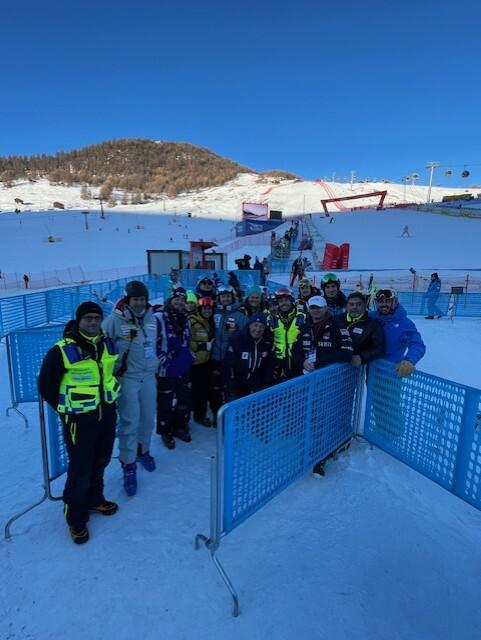
Dr. Bi sits down with mentor and now colleague Alexander Golant, MD, Associate Professor of Orthopaedic Surgery in the Division of Sports Medicine at NYU Langone Health, who stepped into one of the most demanding roles in elite sports: providing medical coverage to the Men’s US Ski Team at the Alpine Ski World Cup race in Livigno, Italy.
Together, they unpack what it takes caring for world-class athletes when every run carries Olympic-level consequences.
BI: I have the pleasure of introducing one of my mentors and now colleagues, Dr. Alexander Golant. Dr. Golant provides joint preservation care for the shoulder, elbow, and knee and serves as one of the volunteer team physicians for the US Ski and Snowboard Team, in addition to coaching alpine ski racing in his free time. In December 2025, he provided medical coverage to the Men’s US Ski & Snowboard Team at the Alpine Ski World Cup race in Livigno, Italy.
Dr. Golant, can you tell us how you got to this particular expertise in ski medicine and your opportunity with the US Ski & Snowboard Team?
GOLANT: Thanks Dr. Bi. Skiing has been a huge part of my life as long as I can remember. I learned to ski almost as early as I learned to walk, raced as a teen and was a ski instructor in college, both on the east coast and out west, and now I coach my kids’ race team in Poconos, Pennsylvania on weekends. From the earliest days of when I entered orthopaedic surgery, it’s been a dream of mine to blend my profession and my passion for skiing.
In 2019, that dream became a reality as I signed up to be a volunteer physician for the US Ski & Snowboard Team. Although the main cadre of professionals who oversee the medical care for the US Alpine Team are located in places like Utah or Colorado, near where the athletes live and train, the US Ski & Snowboard Team (the national governing body for Olympic and Paralympic skiing and snowboarding) relies on a pool of medical volunteers to help provide coverage for training and competition events both at home and all over the world. Many of these physicians are orthopaedic surgeons like me, while many others come from other specialties, such as nonoperative sports medicine, emergency medicine, internal medicine, and others. Before being assigned to an event coverage, every member of the volunteer pool must attend the Medical Emergencies in Skiing and Snowboarding (MESS) course, which provides extensive information and hands-on training for managing emergencies related to snow sports. These various snow sports include alpine, cross-country, freestyle moguls, freestyle aerials, freeski, snowboard, ski jumping, Nordic combined, Para alpine and Para snowboard.
The very first event I covered in 2020 was a famous ski jumping competition, taking place in Germany and Austria, called the Four Hills Tournament. Since then, I have pivoted to the sport that I grew up with, i.e., alpine skiing, and have covered multiple events, including training camp for the alpine speed team in Colorado, as well as several World Cup races in Europe.
BI: What an incredible journey. And what a dream to be able to apply your expertise in your career to your lifetime passion. Can you tell us more about what your responsibilities are when you are tasked with team physician coverage for these elite winter athletes?
GOLANT: The most recent event I covered was the Men’s World Cup Super G race in Livigno, Italy. The role of the physician traveling with the team is to be there in case the athletes or other members of the team become ill or injured.
At the race itself, there is a local medical team that is put in place by the event organizers, consisting of doctors, emergency medical technicians, ski patrol, and other healthcare providers. The onsite team meets with physicians from all the visiting teams to review protocols in case of injury or other emergencies occurring during the race, including the plan for evacuation, location of the nearest trauma centers, and availability of medical services on site. The medical meeting takes place before the start of the race to ensure that all the medical personnel present are acquainted with the protocols specific to each event. In case of an injury on the course, the local emergency team provides the initial assessment and stabilization, and (in case of a non-critical injury) transports the athlete off the course to a location where the athlete’s team physician can then evaluate them and help determine plan for further care.
Athletes with critical injuries may need to be urgently transported (typically airlifted via helicopter) directly from the race course to the nearest trauma center, and in those cases the team physician travels with the athlete to help monitor and oversee their care. In addition to managing any on-snow emergencies, the role of a team physician includes providing off-snow care to the athletes for medical illnesses and other conditions, which can be challenging to an orthopaedic surgeon! I have had to consult medical textbooks and articles on several occasions to refresh my memory on some of the conditions we do not typically see or treat in the orthopaedic world.
BI: Really fascinating stuff! Now tell us more about this most recent trip, for the Men’s World Cup Super G race in Livigno, Italy.
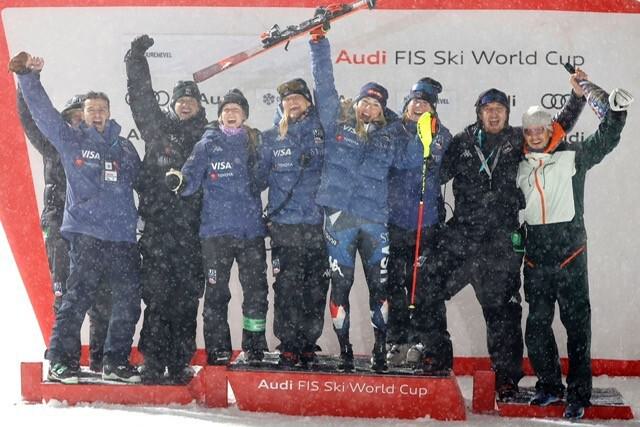
GOLANT: My most recent trip to Livigno was a great event to attend, luckily unmarred by any injuries or complications. This was the first world cup event to take place at this location, and the Italians put on quite a show in honor of the race. The weather cooperated and it was a beautiful, sunny day with firm snow that the racers love so much. Victory went to the Austrian racer Marco Schwartz, and although the US Men’s team did not receive a podium finish, they had a strong showing and thankfully did not sustain any injuries.
BI: How does the US Ski & Snowboard Team coverage obligations affect your practice at home? Are you compensated for your time? How about free time during the trip to either ski on your own or sightsee the destination the team is traveling to?
GOLANT: Many of my friends and colleagues ask why I take time out of my busy work and life schedule to travel to cover these events, and whether I get paid to do so. The answer is, firstly, the volunteer physicians most certainly do not get paid to cover these events. Secondly, we do it for the love of the sport and to ensure these amazing athletes have experienced professionals with them in case anything happens. Every athlete that I have interacted with has been incredibly appreciative of my presence at these events, and that gratitude alone makes this gig worthwhile. That, and the fact that I absolutely love ski racing.