

For many conditions within the field of orthopaedic surgery, the pendulum of treatment swings back and forth over time as new research and data can challenge the status quo.

Sports medicine is a constantly evolving field, looking for evidence-based treatments that can be used to guide decision-making in the office or on the field. The evolution of the treatment of adolescent clavicle fractures over the past few decades is a perfect example of this.
Clavicle fractures are a common injury for many adolescent athletes, especially in sports such as hockey, football, and rugby. Clavicle fractures constitute 10% to 15% of all fractures in adolescents and are the fourth most common upper extremity fracture in the United States.1,2 Often occurring from a fall directly onto the shoulder, clavicular fractures in adolescents were historically treated nonoperatively; however, recent studies within the adult literature showed that operative fixation of displaced, shortened and comminuted fracture patterns resulted in lower rates of nonunion, earlier return to function, and improved patient-reported outcomes.3,4 The extrapolation of these results drove a push towards operative fixation of similar fracture patterns in adolescents, resulting in an increase in surgical management from 2.6% between 2014 and 2016 to 16.1% of patients between 2017 and 2019..5,6,7
Amid this pendulum shift, the Function after Adolescent Clavicle Fracture Trauma and Surgery (FACTS) study group was established to address this issue and provide evidence-based recommendations. Their findings reinforce the long-held pediatric orthopaedic principle that “kids are not little adults.” In contrast to the literature on the treatment of adult clavicle fractures, a multicenter study of eight pediatric orthopaedic centers demonstrated that surgery offered no benefit to the adolescent patient compared to nonoperative management despite the fracture patterns outlined above.8,9 The takeaway is clear: in nearly all cases, less is more when managing adolescent clavicle fractures.
From a musculoskeletal perspective, the rationale for these findings makes sense. The presence of open growth plates allows for treatment decisions that may differ from the adult population. There is substantial clavicle growth and remodeling after 18 years of age due to delayed closure of the clavicular physes relative to other long bones. This allows for increased remodeling and healing potential, permitting successful nonoperative management of these fractures.10,11,12,13
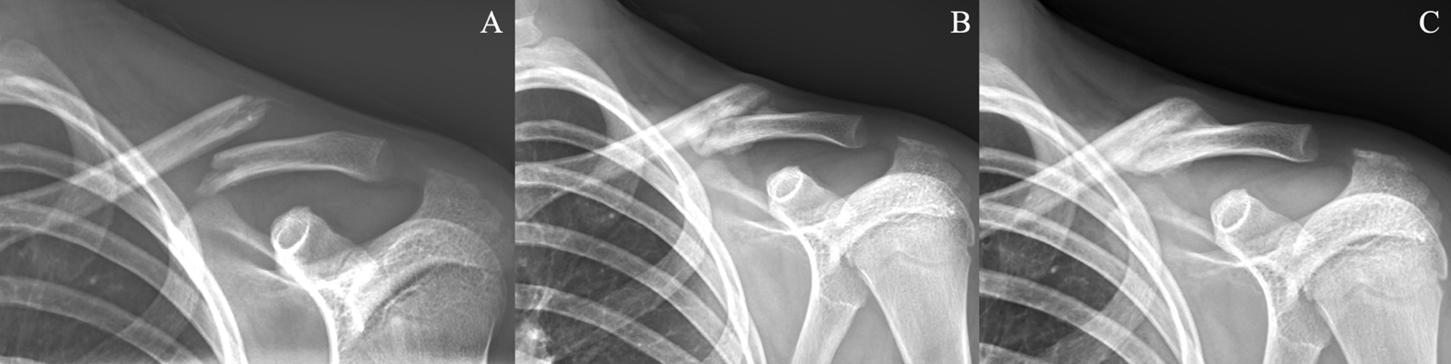
While most of these fractures are amenable to nonoperative management, providers need to be vigilant for the indications warranting immediate referral to an orthopaedic specialist and treatment, including neurovascular compromise and skin tenting. Providers should perform a thorough neurovascular exam of the ipsilateral extremity to rule out neurovascular injury. It is important to differentiate skin tenting, which presents as a pinpoint area of blanching from the sharp edge of fracture pushing through the fascia against the skin, from the generalized lump deformity many of these fractures present with.
After surgical indications have been excluded, non-surgical treatment should be the recommendation for most adolescent clavicle fractures as outlined by the recent multicenter studies above.8,9 Typically, this involves sling use for four to six weeks to reduce movement at the fracture site, allowing callous formation. Once clinical union is achieved where the fracture has healed enough to be stable and allow movement without significant pain, patients should begin range of motion exercises followed by a shoulder strengthening program under the supervision of a physical therapist or athletic trainer. Return to play timing is typically three to four months depending on the type of sport, with contact athletes such as football players requiring a longer time before full clearance due to risk of refracture. Before patients return to sport, they should have radiographic evidence of bony union, full range of motion at the shoulder, and normal strength.
While a fracture may meet criteria for nonoperative treatment, timing of the injury may also play a role in the decision for nonoperative vs. operative fixation. Operative fixation of clavicle fractures does allow for an earlier return to sport, which for a very select subset of athletes may factor into decision-making.
Conclusions
Adolescent clavicle fractures are a common injury and are likely to rise as the number of youth athletes continues to grow. Even with a concerning-looking x-ray, it is important to remember the body’s ability to heal this injury and remodel in adolescent patients with open growth plates.
References
- Caird MS. Clavicle shaft fractures: are children little adults? J Pediatr Orthop. 2012;32 Suppl 1:S1-S4.
- Hubbard EW, Riccio AI. Pediatric orthopedic trauma: an evidence-based approach. Orthop Clin North Am. 2018 Apr;49(2):195-210.
- Canadian Orthopaedic Trauma Society. Nonoperative Treatment Compared with Plate Fixation of Displaced Midshaft Clavicular Fractures. The J Bone Joint Surg. 2007;89(1):1-10.
- Patel, M, Heyworth, BE, Dehghan, N, Mehlman, CT, McKee, MD. Clavicular fractures in the adolescent. J Bone Joint Surg Am. 2023;105(9): 713-723.
- Yang S, Werner BC, Gwathmey FW Jr. Treatment trends in adolescent clavicle fractures. J Pediatr Orthop. 2015;35(3):229-233.
- Sassi, E, Hannonen, J, Serlo, W, Sinikumpu, JJ. Increase in surgical fixation of pediatric midshaft clavicle fractures since 2008. BMC Musculoskelet Disord. 2022; 23(1):173.
- Suppan CA, Bae DS, Donohue KS, Miller PE, Kocher MS, Heyworth BE. Trends in the volume of operative treatment of midshaft clavicle fractures in children and adolescents: a retrospective, 12-year, single-institution analysis. J Pediatr Orthop B. 2016;25(4):305-309.
- Pennock, AT, Bae, DS, Boutelle, K, Busch, MT, Carroll, A, Edmonds, EW, Ellis, HB, Hergott, K, Kocher, MS, Li, Y, Nepple, JJ, Pandya, NK, Perkins, C, Sabatini, CS, Spence, DD, Willimon, SC, Wilson, PL, Heyworth, BE. Remodeling of Adolescent Displaced Clavicle Fractures: A Facts Study. Orthop J Sports Med. 2022;10(5 suppl2):2325967121S00494.
- Heyworth, BE, Pennock, AT, Li, Y, Liotta, ES, Dragonetti, B, Williams, D, Ellis, HB, Nepple, JJ, Spence, D, Clifton Willimon S, Perkins, CA, Pandya, NK, Kocher, MS, Edmonds, EW, Wilson, PL, Busch, MT, Sabatini, CS, Farley, F, Bae, DS. (2022). Two-Year Functional Outcomes of Operative vs Nonoperative Treatment of Completely Displaced Midshaft Clavicle Fractures in Adolescents: Results From the Prospective Multicenter FACTS Study Group. Am J Sports Med. 2022;50(11):3045-3055.
- Shannon, EG, Hart, ES, Grottkau, BE. Clavicle fractures in children: the essentials. Orthop Nurs. 2009;28(5):210-214.
- Phadnis, J, Bain, GI. Normal and pathological anatomy of the shoulder. In: Clavicle Anatomy. Springer; 2015:71-80.
- McGraw, MA, Mehlman, CT, Lindsell, CJ, Kirby, CL. Postnatal growth of the clavicle: birth to 18 years of age. J Pediatr Orthop. 2009;29(8):937-943.
- Hughes, JL, Newton, PO, Bastrom, T, Fabricant, PD, Pennock, AT. (2020). The clavicle continues to grow during adolescence and early adulthood. HSS J. 2020;16(Suppl 2):372-377.
- Bentley, TP, Hosseinzadeh, S. Clavicle fractures. In StatPearls [Internet]. StatPearls Publishing. July 2023.
- Kilkenny, CJ, Daly, GR, Whelehan, SP, Vukanic, D, Alrawashdeh M, Boland, F, Quinlan, JF, Molony, DC. (2024). Return to Play following Clavicular Fracture – A Systematic Review and Meta Analysis. JSES Rev Rep Tech. 2024;5(2):259-269.
