

The rotator cuff is a group of four muscles and their tendons that combine to form a “cuff” around the head of the humerus (the upper end of the arm). The four muscles— supraspinatus, infraspinatus, subscapularis, and teres minor—originate from the scapula (shoulder blade).
The rotator cuff serves to stabilize the humeral head within the joint socket while coordinating the motion of the arm at the shoulder by initiating both lifting and rotation of the arm.
What causes a rotator cuff tear?
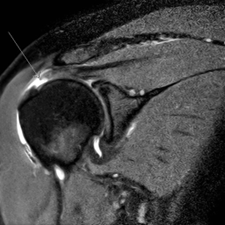
A rotator cuff tear may result from an acute injury such as a fall or may be caused by chronic wear and tear with degeneration of the tendon. Pinching of the tendon on the undersurface of the scapula may contribute to cuff tears in individuals older than 40 years.
How are rotator cuff tears diagnosed?
Rotator cuff tears are initially suspected based upon clinical examination, with findings such as painful or limited motion in partial tears, or weakness and muscle atrophy (shrinking) in complete tears. Diagnostic studies such as MRI (magnetic resonance imaging) or ultrasound can be used to visualize the soft tissues around the shoulder, including the rotator cuff, and can confirm the diagnosis. Early diagnosis and treatment of a rotator cuff tear may help improve overall treatment results.
What is the treatment for a rotator cuff tear?
The goals of treatment are to improve overall shoulder function and quality of life by relieving pain, improving range of motion, and restoring strength to the involved shoulder. Many rotator cuff tears can be treated nonsurgically. Anti-inflammatory medication, steroid injections, and physical therapy may all be of benefit in treating symptoms of a cuff tear. Even though a full-thickness tear cannot heal without surgery, satisfactory function can often be achieved with non-surgical treatments.
At what point does a rotator cuff tear require surgery?
Surgery is recommended if there is persistent pain or weakness in the shoulder that does not improve with nonsurgical treatment. Frequently, patients who require surgery will report pain at night and difficulty using the arm for lifting and reaching. Many will report ongoing symptoms despite several months of medication and limited use of the arm.
Surgery is also indicated in active individuals who use the arm for overhead work or sports.
What options are available for surgical repair?
The type of repair performed is based on the findings at surgery. A small partial tear may require only a trimming or smoothing procedure called a débridement. A nearly full thickness or full-thickness tear with the tendon torn from its insertion on the humerusis repaired directly to bone.
Three techniques are used for rotator cuff repair:
- open repair (through a traditional incision)
- mini-open repair (partially assisted by a camera view, with a smaller incision)
- arthroscopic (performed with only a small camera inserted through multiple small puncture wounds)
What does the recovery and rehabilitation process entail?
Rehabilitation plays a critical role in both the nonsurgical and surgical treatment of a rotator cuff tear. Typical recovery can be six months or more depending on the extent of the tear.
When a tear occurs, there is frequently loss of motion of the shoulder. An exercise or physical therapy program is necessary to regain strength and improve function in the shoulder.
Even though surgery repairs the defect in the tendon, the muscles around the arm remain weak, and a strong effort in rehabilitation is necessary for the procedure to succeed. Complete rehabilitation after surgery may take several months.
Reviewed October 2025 by: Emily Whicker, MD
Expert Consultant: Dan Solomon, MD
STOP Sports Injury tip sheets are brought to you by the American Orthopaedic Society for Sports Medicine.
They provide general information only and are not a substitute for your own good judgment or consultation with a physician. For more tip sheets and to find an expert near you, visit sportsmed.org/STOP
Copyright ©2025. American Orthopaedic Society for Sports Medicine. All rights reserved.