
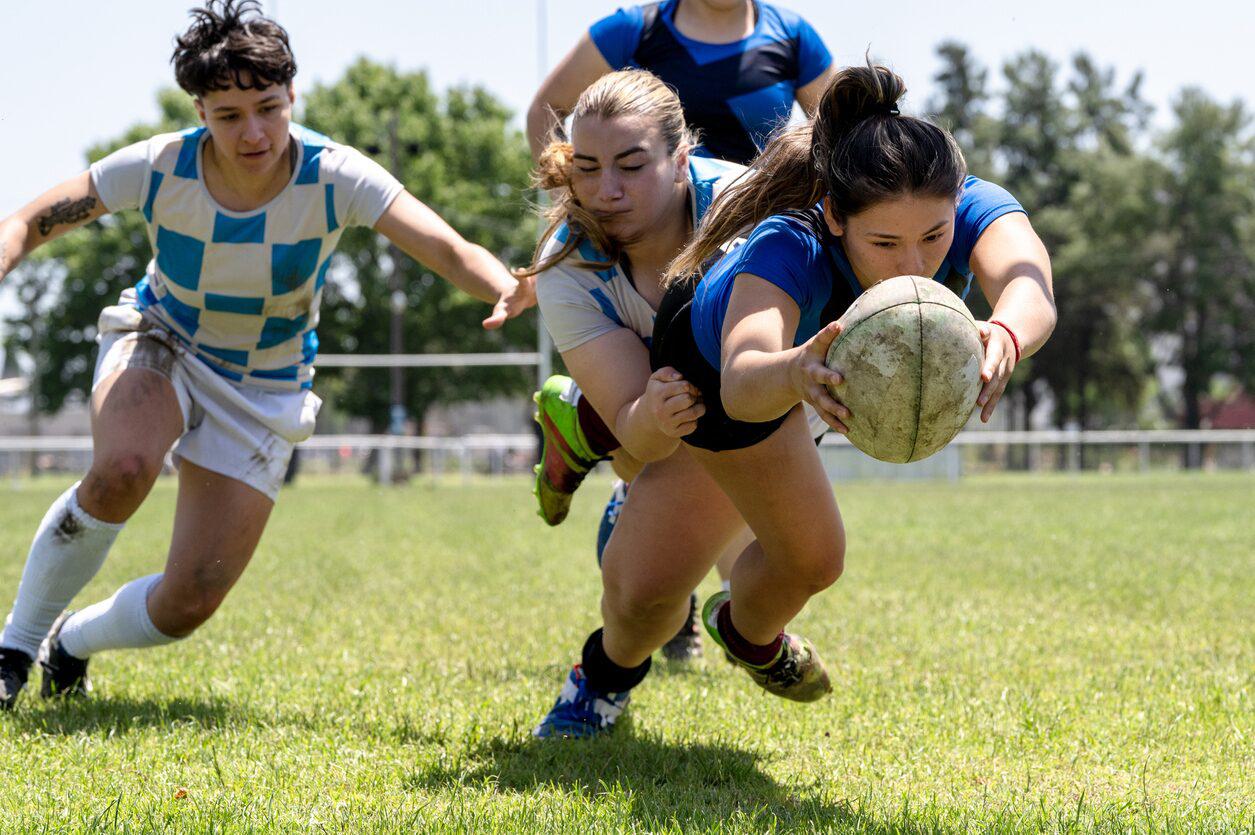
Rugby is one of the most popular sports in the world alongside soccer and cricket. In recent years rugby has been gaining in popularity in the United States with athletes from elementary school to adults playing the game. Now more than 80,000 players are registered with USA Rugby, 20,000 of which are high school age.
What types of injuries are most common in rugby?
Rugby demands the running and endurance of soccer combined with the contact and tackling that is similar to American football. With running there is the potential for overuse injuries
like tendinitis and bursitis. More common, however are traumatic injuries sustained during collisions with other players and/or the ground during scrumming, rucking, and tackling.
Overuse Injuries
Because rugby involves a great deal of running, tendinitis in the knee or ankle, medial tibial stress syndrome (shin splints) and bursitis are all overuse injuries commonly seen. Although these are usually not considered “serious” injuries, they can adversely affect performance and possibly lead to more complicated conditions if not properly addressed by a qualified sports medicine professional.
Traumatic Injuries
Because it is a collision sport, traumatic injuries do occur in rugby. They can include fractured bones, dislocated fingers and elbows, cuts, sprained ligaments and strained tendons or muscles and deep muscle bruises. There has been an increase of facial fractures, especially of the nose because helmets are not worn.
Knee injuries like medial collateral and anterior cruciate ligament sprains and meniscus tears can occur from contact forces or from rotational forces during a quick change of direction. Shoulder injuries from contact with other players or the ground can include sprains of the acromioclavicular joint (AC separation) or dislocations of the glenohumeral joint. Because players do not wear any type of protective mask, cuts on the face are fairly common in rugby players. In addition, rugby tacklers can get injured just as easily as those being tackled due to the lack of protective body pads.
Concussions
As in other sports that involve speed and contact, concussions can and do happen in rugby. Confusion, forgetfulness, dizziness, blurred vision and a headaches are just a few of the possible symptoms of a concussion. Rugby players are traditionally a tough breed and may attempt to continue or return to play after a concussion. However, every player with a suspected concussion should be removed from the practice or game. It is very important that players are properly evaluated and cleared for play from a
qualified medical professional who is experienced and familiar with modern concussion management.
How are rugby injuries treated?
When recovering from a rugby injury there are a few things to consider. As with most sports, regaining strength and flexibility after an injury are important to a successful rehabilitation. Neck, shoulder, hip and core strength, as well as flexibility of the hamstrings and hip flexors are important for overall conditioning and can minimize the chances of an athlete sustaining a secondary injury. Because rugby is a continuously moving sport, working to regain a high level of endurance also plays a large role in the effectiveness of a player returning from a rugby injury.
How can rugby injuries be prevented?
- Practice a balanced and structured training regimen involving strength, flexibility and endurance
- Always use proper technique when tackling, rucking and scrumming
- Learn proper positioning during game play to minimize risky moves
- Maintain proper nutrition and hydration
- Use a quality, properly fitted mouth guard
- Participate at a level consistent with ability
- Adhering to the rules for the formation of the scrum
- Ask your athletic trainer or other sports medicine professional about any training or injury questions
Reviewed September 2025 by Andrew Bi, MD
Expert Consultant: Rob Wassilak, ATC
STOP Sports Injury tip sheets are brought to you by the American Orthopaedic Society for Sports Medicine. They provide general information only and are not a substitute for your own good judgment or consultation with a physician.
For more tip sheets and to find an expert near you, visit sportsmed.org/STOP
Copyright ©2025. American Orthopaedic Society for Sports Medicine. All rights reserved
References
Archbold HAP, Rankin AT, Webb M, Nicholas R, Eames NWA, Wilson RK, Henderson LA, Heyes GJ, Davies R, Bleakley CM. Recurrent injury patterns in adolescent rugby. Phys Ther Sport. 2018 Sep;33:12-17. doi: 10.1016/j.ptsp.2018.06.005. Epub 2018 Jun 18. PMID: 29935429.
Miller JC, Stein KS, Moon TJ, Trofa DP, Kerr H, Bottiglieri T, Ahmad CS. Concussion-Reporting Behavior in Rugby: A National Survey of Rugby Union Players in the United States. Orthop J Sports Med. 2021 Jan 20;9(1):2325967120972141. doi: 10.1177/2325967120972141. PMID: 33786333