
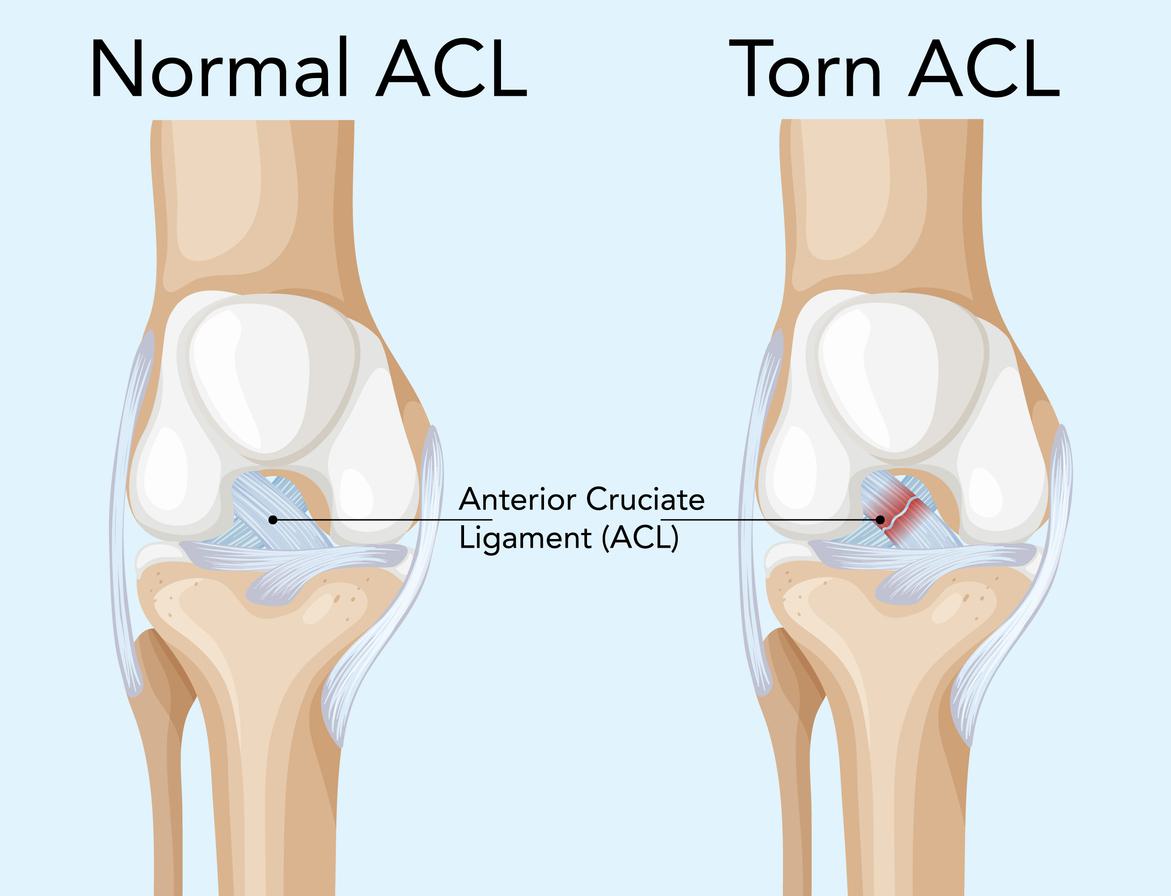
The anterior cruciate ligament (ACL) is a major knee stabilizer that protects against excessive translation and rotation during cutting and pivoting maneuvers. The ACL inserts on the front part of the shin bone (between tibial eminences) and the back part of the thigh bone (lateral femoral condyle). The ACL has two functional bundles, anteromedial and posterolateral, that work together to resist anterior translation and rotation throughout knee range of motion.
How is the ACL injured?
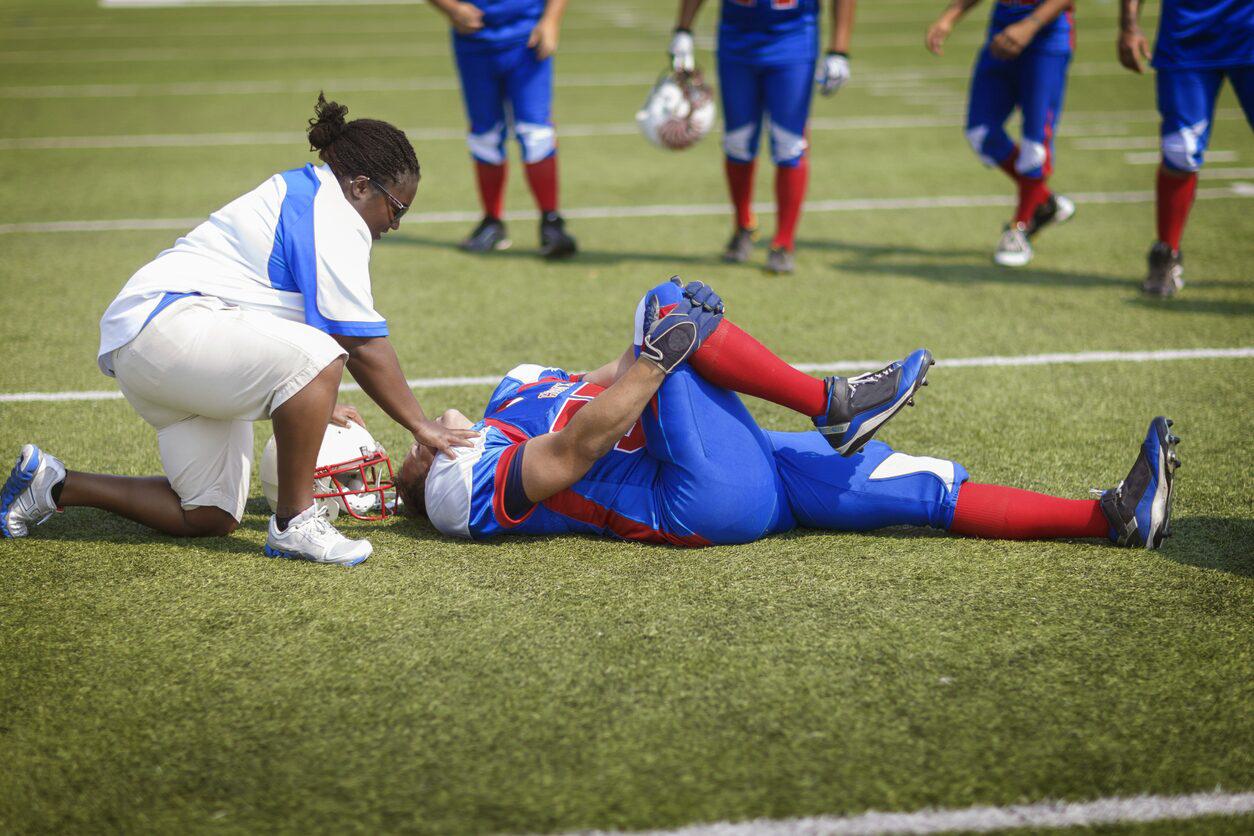
Seventy percent of ACL injuries are non-contact occurring when an athletes changes direction during a cutting or pivoting maneuver or when they land awkwardly from a jump. Non-contact ACL injuries are more common in females versus males. The remaining ACL injuries occur as a result of contact or collision, often injuring other knee structures as well (i.e., MCL).
What are the signs and symptoms of an ACL tear?
The ACL is often torn during a traumatic injury, either non- contact or contact. The athlete will often hear or feel a “pop”, followed by limitation in weight bearing and range of motion secondary to knee swelling. In the setting of chronic ACL deficiency, the athlete will experience repeat giving way or buckling episodes with sports that require changing direction or repetitive jumping and landing.
How is an ACL tear diagnosed?
Most athletes seek medical attention after the first traumatic event with the signs/symptoms described above. A careful history and physical examination by a trained clinician will often lead to a high index of suspicion that an ACL tear has occurred. Positive physical exam findings such as increased anterior translation of the tibia (i.e., anterior drawer, Lachman) and increased knee rotation (pivot shift) are diagnostic of ACL injury. The ACL tear and concomitant injuries (i.e., meniscus or other ligament) can be confirmed by MRI.
Will I need surgery?
This question requires a detailed conversation with a trained orthopaedic surgeon. There are many factors to be considered when deciding surgery versus non-surgical treatment and when deciding between different surgical interventions. In general, athletes of all ages who wish to return to higher level cutting/ pivoting sports should be considered for surgical intervention. Low demand or recreational athletes who do not routinely change directions, land or jump in their sport (e.g., joggers, bikers) may be considered for a trial of non-surgical treatment. The presence of other injuries (i.e., meniscus or cartilage tears) may influence this decision.
Most complete ACL tears do not heal, and those wishing to return to sports typically undergo ACL reconstruction.
In the majority of cases, athletes undergo a period of pre-rehabilitation prior to surgery. The goal of this phase is to decrease swelling and normalize range of motion and gait to help decrease the risk of post-surgical stiffness.
How are ACL tears treated surgically?
There are many different surgical techniques that have evolved through the years for the treatment of ACL tears. The specific technique chosen depends on surgeon experience and patient specific factors. In general, primary repair of the ACL has been considered for only a small (<10%) subset of patients. Novel technique have brought renewed interest in ACL primary repair. However, the vast majority of ACL injuries are still treated with surgical reconstruction, using a tendon from either your own body (i.e., patella tendon, hamstring, quadriceps) or from a cadaver (allograft) to create a new ligament. There are a variety of fixation strategies (i.e., button, screw) and drilling techniques that can be used to reconstruct the ACL. Regardless of chosen technique, the goal of surgery is to stabilize the knee against excessive anterior translation and rotation. Over time, the tendon graft matures and becomes a new, living ligament in your knee.
What happens after surgery?
Rehabilitation after ACL surgery is intensive and requires commitment and dedication. The rate of recovery varies based on type of surgery and other patient specific factors. Return to heavy work (e.g., construction) is usually limited for at least three months or more. Return to sport timeframe depends on activity type and level of competition. In most cases, return to play is not considered for at least 6-9 months following surgery. However, this may take longer depending on type of injury, pace of recovery, and specific requirements of that sport. In general, the outcomes of ACL surgery are excellent for return to work and return to most recreational activities. The outcome with respect to return to pre-injury level of sport competition is variable and remains a significant challenge.
Reviewed September 2025 by Kendall Bradley, MD
Expert Consultant: Wayne J. Sebastianelli, MD
Sports Tips are brought to you by the American Orthopaedic Society for Sports Medicine. They provide general information only and are not a substitute for your own good judgment or consultation with a physician.
For more tip sheets and to find an expert near you, visit sportsmed.org/STOP
Copyright ©2025. American Orthopaedic Society for Sports Medicine. All rights reserved.
References
Ellman MB, Sherman SL, Forsythe B, LaPrade RF, Cole BJ, Bach BR Jr. Return to play following anterior cruciate ligament reconstruction.
J Am Acad Orthop Surg. 2015 May;23(5):283-96.
Sherman SL, Chalmers PN, Yanke AB, Bush-Joseph CA, Verma NN, Cole BJ, Bach BR Jr. Graft tensioning during knee ligament reconstruction: principles and practice. J Am Acad Orthop Surg. 2012 Oct;20(10):633-45.